Sardar Vallabhbhai Patel
Sardar Vallabhbhai Patel
“All their speeches were fill of communal poison“, he wrote after banning the Sangh in 1948. “As a final result of the poison, the country had to suffer the sacrifice of the invaluable life of Gandhiji.”
On November 13, 1947, Sardar Patel, the then deputy Prime Minister of India, vowed to rebuild Somnath Temple. Somnath had been destroyed and built several times in the past. He felt that the story of its resurrection from ruins this time would be symbolic of the story of the resurgence of India.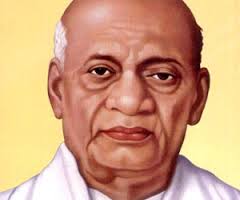
Patel took charge of the integration of the princely states into India.[53] This achievement formed the cornerstone of Patel's popularity in the post-independence era. Even today he is remembered as the man who united India. He is, in this regard, compared to Otto von Bismarck who unified the many German states in 1871.[64] Under the plan of 3 June, more than 565 princely states were given the option of joining either India or Pakistan, or choosing independence. Indian nationalists and large segments of the public feared that if these states did not accede, most of the people and territory would be fragmented. The Congress, as well as senior British officials, considered Patel the best man for the task of achieving conquest of the princely states by the Indian dominion. Gandhi had said to Patel, "he problem of the States is so difficult that you alone can solve it".[65] Patel was considered a statesman of integrity with the practical acumen and resolve to accomplish a monumental task. He asked V. P. Menon, a senior civil servant with whom he had worked on the partition of India, to become his right-hand man as chief secretary of the States Ministry. On 6 August 1947, Patel began lobbying the princes, attempting to make them receptive towards dialogue with the future government and forestall potential conflicts. Patel used social meetings and unofficial surroundings to engage most of the monarchs, inviting them to lunch and tea at his home in Delhi. At these meetings, Patel explained that there was no inherent conflict between the Congress and the princely order. Patel invoked the patriotism of India's monarchs, asking them to join in the independence of their nation and act as responsible rulers who cared about the future of their people. He persuaded the princes of 565 states of the impossibility of independence from the Indian republic, especially in the presence of growing opposition from their subjects. He proposed favourable terms for the merger, including the creation of privy purses for the rulers' descendants. While encouraging the rulers to act out of patriotism, Patel did not rule out force. Stressing that the princes would need to accede to India in good faith, he set a deadline of 15 August 1947 for them to sign the instrument of accession document. All but three of the states willingly merged into the Indian union; only Jammu and Kashmir, Junagadh, and Hyderabad did not fall into his basket.[66]
Patel was born in Nadiad District Kheda and raised in the countryside of the state of Gujarat.[5] He was a successful lawyer. He subsequently organised peasants from Kheda, Borsad, and Bardoli in Gujarat in non-violent civil disobedience against the British Raj, becoming one of the most influential leaders in Gujarat. He was appointed as the 49th President of Indian National Congress, organising the party for elections in 1934 and 1937 while promoting the Quit India Movement.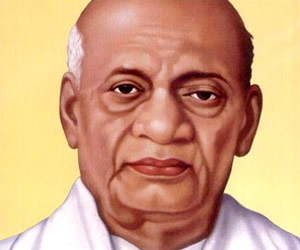
The other is the R.S.S. I have made them an open offer. Change your plans, give up secrecy, respect the Constitution of India, show your loyalty to the (National) Flag and make us believe that we can trust your words. Whether they are friends or foes, and even if they are our own dear children, we are not going to allow them to play with fire so that the house may be set on fire. It would be criminal to allow young men to indulge in acts of violence and destruction.. Sardar Vallabhbhai Patel, Speaking on RSS, during a public speech.[96][97]
He was also instrumental in the creation of the All India Services which he described as the country's "Steel Frame". In his address to the probationers of these services, he asked them to be guided by the spirit of service in day-to-day administration. He reminded them that the ICS was no-longer neither Imperial, nor civil, nor imbued with any spirit of service after Independence. His exhortation to the probationers to maintain utmost impartiality and incorruptibility of administration is as relevant today as it was then. "A civil servant cannot afford to, and must not, take part in politics. Nor must he involve himself in communal wrangles. To depart from the path of rectitude in either of these respects is to debase public service and to lower its dignity," he had cautioned them on 21 April 1947.[83]
Following Gandhiji’s assassination, he said: “I claim to be nothing more than an obedient soldier of him like the millions who obeyed his call. There was a time when everyone used to call me his blind follower. But, both he and I knew that I followed him because our convictions tallied”.
Patel had long been the rival of Nehru for party leadership, but Nehru usually prevailed over the older man, who died in 1950.[86] Subsequently, J. R. D. Tata, the Industrialist, Maulana Azad and several others expressed the opinion that Patel would have made a better Prime Minister for India than Nehru.[128] These Patel admirers and Nehru's critics cite Nehru's belated embrace of Patel's advice regarding the UN and Kashmir and the integration of Goa by military action and Nehru's rejection of Patel's advice on China.[129] Proponents of free enterprise cite the failings of Nehru's socialist policies as opposed to Patel's defence of property rights and his mentorship of what was to be later known as the Amul co-operative project.[130][131] However, A. G. Noorani, in comparing Nehru and Patel, writes that Nehru had a broader understanding of the world than Patel.[132]
When Nehru pressured Rajendra Prasad to decline a nomination to become the first President of India in 1950 in favour of Rajagopalachari, he angered the party, which felt Nehru was attempting to impose his will. Nehru sought Patel's help in winning the party over, but Patel declined, and Prasad was duly elected. Nehru opposed the 1950 Congress presidential candidate Purushottam Das Tandon, a conservative Hindu leader, endorsing Jivatram Kripalani instead and threatening to resign if Tandon was elected. Patel rejected Nehru's views and endorsed Tandon in Gujarat, where Kripalani received not one vote despite hailing from that state himself.[94] Patel believed Nehru had to understand that his will was not law with the Congress, but he personally discouraged Nehru from resigning after the latter felt that the party had no confidence in him.[95]
COAID- SVIT, Vasad has established it’s distinguished identity since 2000 in the field of Bachelor In Architecture along with it’s new branches of Interior Design, Master’s in Architecture and Diploma Architecture. The balanced amalgamation of three arenas: Architecture, Art and Design make us unique. In this rapidly changing world, where creation and interaction make the world come together beyond the periphery of distance and time. We nurture students to explore beyond the boundaries of the studio while engaging them into hand’s on workshops, site visits, RSPs and on site visit. We also provide national and international placements opportunities to students. During the current pandemic, In order to provide knowledge to the students virtually; our faculties are completely equipped to mould their knowledge into their distinct teaching techniques. We whole heartedly welcome all the students to be the part of COAID family
Vocational education or Vocational Education and Training (VET), also called Career and Technical Education (CTE), prepares learners for jobs that are based in manual or practical activities, traditionally non-academic and totally related to a specific trade, occupation or vocation, hence the term, in which the learner participates. It is sometimes referred to as technical education, as the learner directly develops expertise in a particular group of techniques or technology. READ MORE
However, Patel was never communal. As Home Minister, he did his best to protect Muslim lives in Delhi during riots. Patel had a Hindu heart (because of his upbringing) but he ruled with an impartial and secular hand.
Patel's health declined rapidly through the summer of 1950. He later began coughing blood, whereupon Maniben began limiting her meetings and working hours and arranged for a personalised medical staff to begin attending to Patel. The Chief Minister of West Bengal and doctor Bidhan Roy heard Patel make jokes about his impending end, and in a private meeting Patel frankly admitted to his ministerial colleague N. V. Gadgil that he was not going to live much longer. Patel's health worsened after 2 November, when he began losing consciousness frequently and was confined to his bed. He was flown to Bombay on 12 December on advice from Dr Roy, to recuperate as his condition was deemed critical.[113] Nehru, Rajagopalachari, Rajendra Prasad, and Menon all came to see him off at the airport in Delhi. Patel was extremely weak and had to be carried onto the aircraft in a chair. In Bombay, large crowds gathered at Santacruz Airport to greet him. To spare him from this stress, the aircraft landed at Juhu Aerodrome, where Chief Minister B. G. Kher and Morarji Desai were present to receive him with a car belonging to the Governor of Bombay that took Vallabhbhai to Birla House.[114][115]
Junagadh was especially important to Patel, since it was in his home state of Gujarat. It was also important because in this Kathiawar district was the ultra-rich Somnath temple (which in the 11th century had been plundered by Mahmud of Ghazni, who damaged the temple and its idols to rob it of its riches, including emeralds, diamonds, and gold). Under pressure from Sir Shah Nawaz Bhutto, the Nawab had acceded to Pakistan. It was, however, quite far from Pakistan, and 80% of its population was Hindu. Patel combined diplomacy with force, demanding that Pakistan annul the accession, and that the Nawab accede to India. He sent the Army to occupy three principalities of Junagadh to show his resolve. Following widespread protests and the formation of a civil government, or Aarzi Hukumat, both Bhutto and the Nawab fled to Karachi, and under Patel's orders the Indian Army and police units marched into the state. A plebiscite organised later produced a 99.5% vote for merger with India.[67] In a speech at the Bahauddin College in Junagadh following the latter's take-over, Patel emphasised his feeling of urgency on Hyderabad, which he felt was more vital to India than Kashmir:
In 1928, the farmers of Bardoli again faced a problem of "tax-hike". After prolonged summons, when the farmers refused to pay the extra tax, the government seized their lands in retaliation. The agitation took on for more than six months. After several rounds of negotiations by Patel, the lands were returned to farmers after a deal was struck between the government and farmers’ representatives.
The differences of opinion were mostly regarding the Congress hierarchy, working style, or ideologies. Within Congress – Nehru was widely considered Left-wing (socialism) while Patel’s ideologies were aligned with the Right-wing (capitalism).
Patel's family home in Karamsad is preserved in his memory.[140] The Sardar Vallabhbhai Patel National Memorial in Ahmedabad was established in 1980 at the Moti Shahi Mahal. It comprises a museum, a gallery of portraits and historical pictures, and a library containing important documents and books associated with Patel and his life. Amongst the exhibits are many of Patel's personal effects and relics from various periods of his personal and political life.[141]
As Gandhi embarked on the Dandi Salt March, Patel was arrested in the village of Ras and was put on trial without witnesses, with no lawyer or journalists allowed to attend. Patel's arrest and Gandhi's subsequent arrest caused the Salt Satyagraha to greatly intensify in Gujarat – districts across Gujarat launched an anti-tax rebellion until and unless Patel and Gandhi were released.[32] Once released, Patel served as interim Congress president, but was re-arrested while leading a procession in Bombay. After the signing of the Gandhi–Irwin Pact, Patel was elected president of Congress for its 1931 session in Karachi – here the Congress ratified the pact and committed itself to the defence of fundamental rights and civil liberties. It advocated the establishment of a secular nation with a minimum wage and the abolition of untouchability and serfdom. Patel used his position as Congress president to organise the return of confiscated land to farmers in Gujarat.[33] Upon the failure of the Round Table Conference in London, Gandhi and Patel were arrested in January 1932 when the struggle re-opened, and imprisoned in the Yeravda Central Jail. During this term of imprisonment, Patel and Gandhi grew close to each other, and the two developed a close bond of affection, trust, and frankness. Their mutual relationship could be described as that of an elder brother (Gandhi) and his younger brother (Patel). Despite having arguments with Gandhi, Patel respected his instincts and leadership. In prison, the two discussed national and social issues, read Hindu epics, and cracked jokes. Gandhi taught Patel Sanskrit. Gandhi's secretary, Mahadev Desai, kept detailed records of conversations between Gandhi and Patel.[34] When Gandhi embarked on a fast-unto-death protesting the separate electorates allocated for untouchables, Patel looked after Gandhi closely and himself refrained from partaking of food.[35] Patel was later moved to a jail in Nasik, and refused a British offer for a brief release to attend the cremation of his brother Vithalbhai, who had died in October 1933. He was finally released in July 1934.[citation needed]
Hyderabad was the largest of the princely states, and it included parts of present-day Telangana, Andhra Pradesh, Karnataka, and Maharashtra states. Its ruler, the Nizam Osman Ali Khan, was a Muslim, although over 80% of its people were Hindu. The Nizam sought independence or accession with Pakistan. Muslim forces loyal to Nizam, called the Razakars, under Qasim Razvi, pressed the Nizam to hold out against India, while organising attacks on people on Indian soil. Even though a Standstill Agreement was signed due to the desperate efforts of Lord Mountbatten to avoid a war, the Nizam rejected deals and changed his positions.[68] In September 1948 Patel emphasised in Cabinet meetings that India should talk no more, and reconciled Nehru and the Governor-General, Chakravarti Rajgopalachari, to military action. Following preparations, Patel ordered the Indian Army to invade Hyderabad (in his capacity as Acting Prime Minister) when Nehru was touring Europe.[69] The action was termed Operation Polo, and thousands of Razakar forces were killed, but Hyderabad was forcefully secured and integrated into the Indian Union.[70] The main aim of Mountbatten and Nehru in avoiding a forced annexation was to prevent an outbreak of Hindu–Muslim violence. Patel insisted that if Hyderabad were allowed to continue as an independent nation enclave surrounded by India, the prestige of the government would fall, and then neither Hindus nor Muslims would feel secure in its realm. After defeating Nizam, Patel retained him as the ceremonial chief of state, and held talks with him.[71]There were 562 princely states in India which Sardar Patel integrated.
The other is the R.S.S. I have made them an open offer. Change your plans, give up secrecy, respect the Constitution of India, show your loyalty to the (National) Flag and make us believe that we can trust your words. Whether they are friends or foes, and even if they are our own dear children, we are not going to allow them to play with fire so that the house may be set on fire. It would be criminal to allow young men to indulge in acts of violence and destruction..
Indian National Congress, broadly based political party of India. Formed in 1885, the Indian National Congress dominated the Indian movement for independence from Great Britain. It subsequently formed most of India’s governments from the time of independence and often had a strong presence in many state governments.…
Patel practised law in Godhra, Borsad, and Anand while taking on the financial burdens of his homestead in Karamsad. Patel was the first chairman and founder of "Edward Memorial High School" Borsad, today known as Jhaverbhai Dajibhai Patel High School. When he had saved enough for his trip to England and applied for a pass and a ticket, they were addressed to "V. J. Patel," at the home of his elder brother Vithalbhai, who had the same initials as Vallabhai. Having once nurtured a similar hope to study in England, Vithalbhai remonstrated his younger brother, saying that it would be disreputable for an older brother to follow his younger brother. In keeping with concerns for his family's honour, Patel allowed Vithalbhai to go in his place.[16]
Patel was the leading candidate for the 1945–46 presidency of the Indian National Congress, but Gandhi once again intervened for the election of Nehru. Nehru, as president of the Congress, was invited by the British viceroy to form an interim government. Thus, in the normal course of events, Patel would have been the first prime minister of India. During the first three years of independence, Patel was deputy prime minister, minister of home affairs, minister of information, and minister of states; above all, his enduring fame rests on his achievement of the peaceful integration of the princely Indian states into the Indian Union and the political unification of India.
The Governor-General of India, Chakravarti Rajagopalachari, along with Nehru and Patel, formed the "triumvirate" that ruled India from 1948 to 1950. Prime Minister Nehru was intensely popular with the masses, but Patel enjoyed the loyalty and the faith of rank and file Congressmen, state leaders, and India's civil servants. Patel was a senior leader in the Constituent Assembly of India and was responsible in large measure for shaping India's constitution.[72]
While Nehru, Rajagopalachari, and Maulana Azad initially criticised Gandhi's proposal for an all-out campaign of civil disobedience to force the British to grant Indian independence, Patel was its most fervent supporter. Arguing that the British would retreat from India as they had from Singapore and Burma, Patel urged that the campaign start without any delay.[42] Though feeling that the British would not leave immediately, Patel favoured an all-out rebellion that would galvanise the Indian people, who had been divided in their response to the war, In Patel's view, such a rebellion would force the British to concede that continuation of colonial rule had no support in India, and thus speed the transfer of power to Indians.[43] Believing strongly in the need for revolt, Patel stated his intention to resign from the Congress if the revolt were not approved.[44] Gandhi strongly pressured the All India Congress Committee to approve an all-out campaign of civil disobedience, and the AICC approved the campaign on 7 August 1942. Though Patel's health had suffered during his stint in jail, he gave emotional speeches to large crowds across India,[45] asking them to refuse to pay taxes and to participate in civil disobedience, mass protests, and a shutdown of all civil services. He raised funds and prepared a second tier of command as a precaution against the arrest of national leaders.[46] Patel made a climactic speech to more than 100,000 people gathered at Gowalia Tank in Bombay on 7 August:

Comments
Post a Comment